

Selected Works is a weekly (usually) newsletter by the Te Whanganui-a-Tara, Aotearoa (Wellington, New Zealand) based freelance music journalist, broadcaster, copywriter and sometimes DJ Martyn Pepperell, aka Yours Truly. Most weeks, Selected Works consists of a recap of what I’ve been doing lately, along with some of what I’ve been listening to and reading, paired with film photographs I’ve taken, plus some bonuses. All of that said, sometimes it takes completely different forms.
RAIZA BIZA: PANGEA
Last week, the Rwandan New Zealand rapper Raiza Biza released his latest album, Pangea. I just want to extend some thanks to Biza for inviting me to write the sales notes for Pangea. I’ve reproduced them below.
During Earth’s early geological history, Pangea was a supercontinent encompassing almost all of the planet’s landmasses. It’s shorthand for a time when everything was connected, and a metaphor for the idea that we were all once one. Over hundreds of millions of years, the supercontinent fractured and drifted apart, eventually forming the world as we know it today.
Today, the fractures aren’t only geographic. We’re socially, culturally, and philosophically splintered across a multiverse of competing realities. In his lifetime, Raiza Biza, a celebrated Rwandan hip-hop artist who grew up in Zambia, the Democratic Republic of Congo, South Africa, and New Zealand, has used music to navigate and connect these realms. He’s a unifying force who helps disparate people find common ground.
Over the past thirteen years, Raiza has released at least one project annually, culminating in his forthcoming album, also titled Pangea. Along the way, he has collaborated with a global cast of underground and forward-thinking artists, including Oddisee, Black Milk, Sampa The Great, REMI, Melodownz, and JessB, playing a key role in the emergence of a new generation of African hip-hop voices across New Zealand and Australia. Fittingly, his work has taken him to stages across Europe and Asia, where he has built an international audience.
In 2021, Raiza returned to Rwanda, reconnecting with the Land of a Thousand Hills while immersing himself in the East African republic’s rapidly evolving hip-hop, R&B, and afrobeats scenes. At the same time, he has continued to refine a songwriting approach that balances philosophical introspection with the energy of the dancefloor.
Created during this period of transition, Pangea brings together collaborators from New Zealand, Australia, and Rwanda, including JDRO, Achai, TK Paradza, JessB, Rubi Du, Blaze The Emperor, Romeo Rapstar, UNVRSS, and Mazbou Q, for a wide-ranging exploration of home, identity, connection, dislocation, nightlife, and the questions that linger in the morning light.
The album is supported by a production team spanning New Zealand, Zimbabwe, and Rwanda, Swissberry, TK Paradza, Skinni, Jeje Pro, Dr Ngangi, and Mazbou Q, who provide a backdrop of hip-hop, afrobeats, and neo-soul. Together, they draw on both the gloss of Y2K-era rap and the forward-facing club sounds shaping contemporary African music.
If singles like ‘Get Money’, ‘Diaspora’, ‘Chapati’, and ‘Mocha’ have offered glimpses into Raiza’s recent work, Pangea offers a widescreen vision. Now based in the homeland he spent much of his life dreaming about, he steps forward with a project that brings his story, and community, into sharp focus. The prodigal son has returned home, but he remains tied to many places.
HERBERT MUSIC:
In general, I’ve never been that captivated by talk-to-camera social media accounts. Fair play to anyone trying to make that paradigm work; it’s just not my thing. That all being said, I recently came across an account that made me start wondering if I might be about to change my tune—@herbert.music.
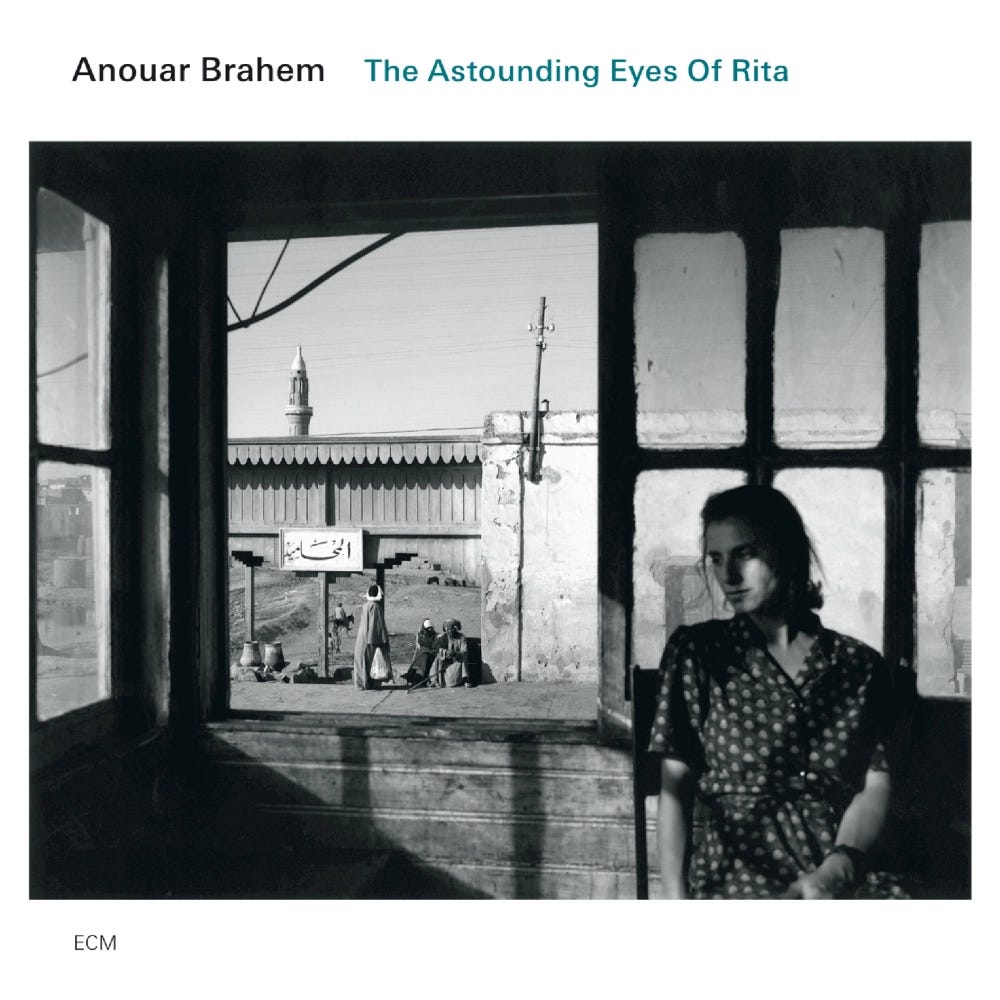
The owner of the account, Daria Challah, describes herself as a classical music writer, presenter and digital storyteller driven by a mission to bring classical music to new and younger audiences. Recently, she uploaded a video about an album that the oud player Anouar Brahem recorded for ECM in 2009, The Astounding Eyes of Rita. You can watch it below.
In the video, Challah speaks with extraordinary passion and conviction about the story behind The Astounding Eyes of Rita, Brahem’s lifelong relationship with the oud, and how two forces can be simultaneously drawn together and pushed apart. Her pitch absolutely landed with me. I’ve listened to the album several times since.
ECM describe The Astounding Eyes of Rita as “A dance of dark, warm sounds, urged onward by the darbouka and frame drum of Lebanese percussionist Khaled Yassine,” while also noting the album is dedicated to the memory of Palestinian poet Mahmoud Darwish.
In the early 1960s, in Haifa, Israel, Darwish fell in love with Tamar Ben Ami, a Jewish Israeli dancer. Their romance was intense but brief. From this forbidden love, the writer composed a poignant poem, ‘Rita and the Rifle,’ which is still sung throughout the Arab world. When ECM say The Astounding Eyes of Rita is dedicated to the memory of Darwish, it’s shorthand for the fact that the album was inspired by the poem. You can read an article about ‘Rita and the Rifle’ over at Le Monde here.
FIVE TAKEAWAYS FROM MY RECENT INTERVIEW WITH CHE FU:
Despite what you might think, Ché Fu never saw himself as a leader. However, in the wake of the success of his debut solo album 2b S.Pacific in 1998, the celebrated Māori Niuean singer-songwriter, producer, and DJ realised he would have to become one if he wanted to fully realise the music that lived inside his head. The process that followed was hard work, but it paid off.
Last month, I interviewed him for Rolling Stone to promote the 20th anniversary of his second album, Navigator, and the accompanying tour he’s going on to support that soon. You can check out the details over here.
GEOFF MURPHY TAUGHT CHE HOW TO DIRECT MUSIC VIDEOS
Geoff Murphy was a central figure in the New Zealand film new wave that emerged in the 1970s. His movie Goodbye Pork Pie became the first local blockbuster of the era. He completed a hat-trick with Utu and sci-fi classic The Quiet Earth. Skilled at action, knockabout comedy, and melding genres, Murphy spent ten years in Hollywood before returning home for further screen adventures.
“Geoff Murphy taught me a lot about directing. He was very helpful when I was trying to direct my own music videos.” - Che Fu
GEOFF MURPHY’S SOUND GUY, DICK READE, SHOWED CHE THE BASICS OF AUDIO ENGINEERING
Sound recordist Dick Reade’s list of awards includes gongs for his work on The Navigator, Mt Zion, After the Waterfall and When Love Comes — and an Emmy nomination for TV’s Buggin’ with Ruud. In 2007 he was named SPADA/Onfilm industry champion. After more than a decade with state television, Reade went freelance in the early 80s. These days he runs his own studio in West Auckland.
“A super OG also guided us by the name of Dick Reade, a super-master film, television, and music soundman who worked with Blerta… Dick Reade is from that same world. He worked as a sound engineer on a lot of Geoff’s films. One of the coolest things Dick ever did, in my opinion, was working on Mad Max. He got to be a part of one of the highest-grossing B-movies known to man.” - Che Fu
WHEN HE WAS RECORDING NAVIGATOR, CHE WORKED WITH A SOUND TECH WHO TOOK HIP-HOP VERY SERIOUSLY
“One of the cool things that happened was working with the engineer and producer Neil Baldock. When we were laying the drums, I showed him this article from a graffiti magazine. It was about a series of compilation albums that the DJ Breakbeat Lou compiled called Ultimate Breaks and Beats.
In the article, they talked to the engineer who recorded a lot of the funk, soul and rock 7”s that ended up on those compilations. Turntablists used to use them when they were juggling beats. Neil took the article home. The next day, he started applying some of the techniques when we were recording the drums for ‘Misty Frequencies’. It was so awesome to have that freedom.” - Che Fu
CHE THINKS THA FEELSTYLE DESERVES MORE CREDIT
The Samoan-born MC Kas aka Tha Feelstyle has long been celebrated amongst Aotearoa’s hip hop elite for his ability to craft music in both his native Samoan and English. The rapper earned a place in the history books, under the name RIQ, when he edged out Upper Hutt Posse to win the country’s first-ever MC battle in 1987. He’s been in demand since, working closely with a list of Kiwi music’s who’s who and dominating the 2005 Pacific Music Awards with debut album Break It To Pieces.
“Kas needs to get more flowers as well. I never spoke about it much, but he was hugely influential on me. Kas taught me about abstract rhymes. I remember he had a rhyme book with lines written in it like “hibiscus milk falling from the tree of eternity.” He blew my mind.” - Che Fu
SOME OF NAVIGATOR’S FANS BLEW CHE’S MIND
“I got this letter from [the late Māori rights activist and politician] Tariana Turia. The reason why I say that is it freaked me out how well she knew my tunes. She broke them down to me. As a songwriter, it’s really beautiful and interesting when people tell me about the impact my music has had on them. To know my tunes go beyond just having a jiggle means a lot. It’s the best feeling.” - Che Fu
FIN.